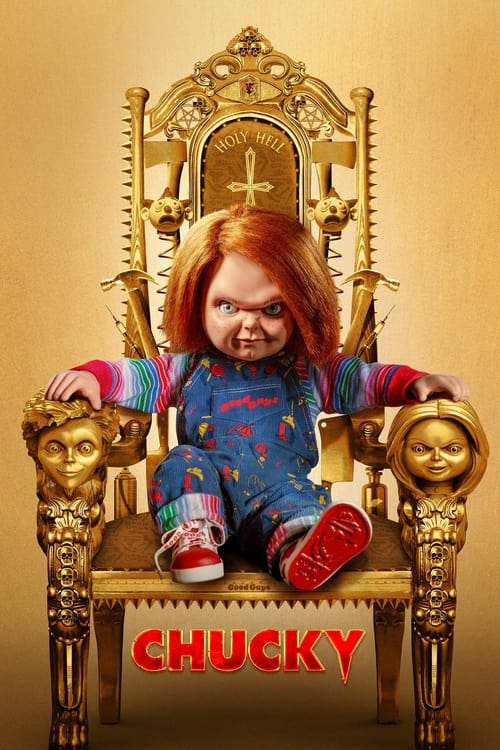
Chucky
Season 2 Analysis
Season Overview
While Jake and Devon encounter trouble as a couple at their new Catholic school, Chucky embarks on a whole new killing spree, crossing paths with familiar faces along the way.
Season Review
Categorical Breakdown
The main plot centers the experiences of the protagonists through the lens of their sexual orientation, treating their gay identity as a source of conflict with the oppressive authority figures in the Catholic school setting. A secondary character, one of Tiffany's children, is non-binary and embodies a storyline focused on gender identity and dysphoria. The narrative prioritizes immutable characteristics, specifically sexual and gender identity, as the primary source of the characters' external adversity.
The central institutional setting for the season is a Catholic reform school, a facility for juvenile offenders run by the Catholic Church. The creator's intention was to have the killer doll subvert and go after authority figures, using the Catholic Church to explore the history of conflict between the institution and the LGBTQ+ community. The show directly frames this foundational Western institution as a hostile and oppressive environment, with one review noting the show 'playfully lambast[s] religion’s dated and clueless handlings of everything.'
The female lead, Lexy, is portrayed as highly traumatized and dealing with substance abuse issues, contrasting with the 'Girl Boss' trope by being severely flawed and struggling. However, the season prominently features the non-binary child of Chucky and Tiffany, Glenda, whose story arc involves a metaphor for gender dysphoria, strongly promoting gender ideology. Motherhood is portrayed negatively, with Lexy's mother being depicted as a bad parent who blames her daughter, and the villainous Tiffany being the mother of the aforementioned non-binary and trouble-prone children.
Alternative sexualities are a centerpiece of the series, with the main protagonists, Jake and Devon, being a gay couple whose relationship is a primary driver of the plot and source of conflict within the Catholic school. The season introduces Glenda, a non-binary character, and explores their story using a dialogue that is a 'subtle and very well-meshed metaphor for dysphoria.' The creator explicitly sought to explore themes of 'religion and queer sexuality' in the season, centering sexual identity as the most important trait in the protagonists' journey.
The plot is framed around Chucky 'fighting the Catholic Church' after the queer protagonists are sent to a Catholic reform school. Characters representing the Church, such as Father Bryce and Sister Ruth, are frequently depicted as clueless, overly dogmatic, or even comically ineffectual in the face of the supernatural evil. The narrative's premise is built on the satirical opposition of the murderous doll and the homosexual main characters against the authority of a traditional religious institution, framing traditional religion as the villainous or hostile 'status quo' that Chucky helps to subvert.