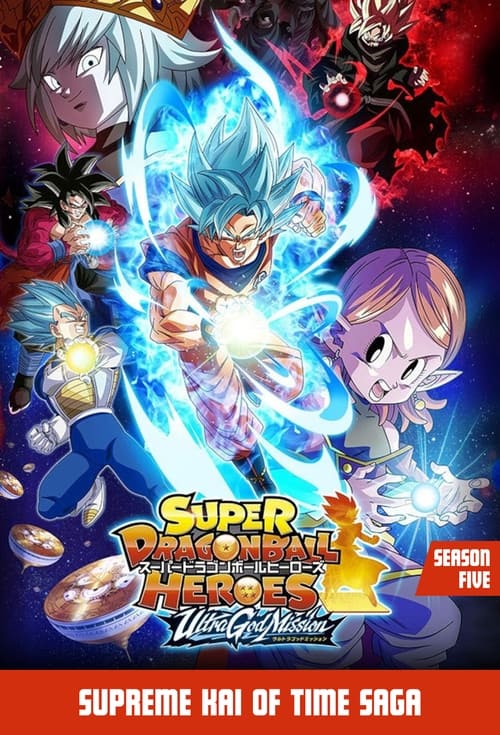
Super Dragon Ball Heroes
Season 5 Analysis
Season Overview
No specific overview for this season.
Season Review
Categorical Breakdown
Characters are valued and gain significance strictly based on their power level, skill, and ability to contribute to the fight, representing a pure universal meritocracy. The conflict is between heroes and villains defined by moral alignment and strength, not race, privilege, or any immutable characteristic. There is no use of an intersectional lens.
The main goal of the heroes is to protect their homes, universes, and timelines from cosmic destruction, such as the universal experiments of villains like Fu or the threats posed by the Super Space-Time Tournament. The narrative frames the existing civilization and home as a good entity to be defended from existential chaos.
The core power structure is dominated by men (Goku, Vegeta, Xeno Goku, Xeno Vegeta), who achieve higher power levels through rigorous, competitive training. Female characters, while present as powerful figures (Supreme Kai of Time Chronoa, Mai), largely retain traditional roles as support, authority figures, or love interests. The story avoids emasculation of the male characters, whose masculinity is directly tied to their protective strength, and there is no anti-natalist messaging.
The narrative is completely centered on high-stakes, time-breaking combat and power acquisition. There is no presence of sexual identity as a focal point, the deconstruction of the male-female pair, or any discussion/lecturing on gender theory. Traditional male-female relationships are the normative structure that exists privately in the background.
The world includes an established, objective hierarchy of gods and divine beings (Angels, Supreme Kais, Gods of Destruction, Grand Priest) who govern the cosmos. The moral conflict is a clear battle against cosmic evil, establishing an objective moral law (protect the universe) that is acknowledged by the divine structure. Faith and transcendent concepts, such as Ultra Instinct, are sources of great power.