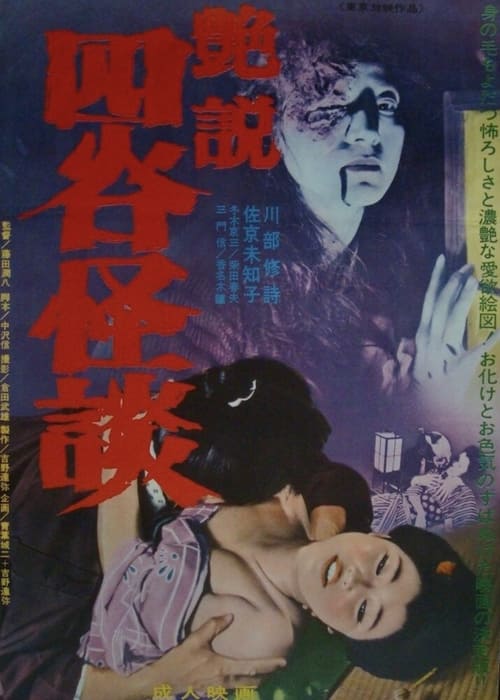
Glossy Yotsuya Ghost Story
Plot
The pinku version of the famous ghost story Yotsuya Kaidan.
Get the Weekly Woke Watchlist
New and trending movies scored for woke bias, preachy messaging, and forced political themes — before you waste your evening.
No spam. One useful email per week.
Overall Series Review
Categorical Breakdown
Characters are judged strictly on their moral choices and personal actions, not on immutable characteristics or intersectional hierarchy. The story is a Japanese period piece set in feudal Japan with an ethnically authentic cast; there is no vilification of 'whiteness' or forced diversity. The conflict is class-based (poor samurai wanting to marry into wealth) and moral.
The film is a Japanese ghost story (*kaidan*) set in feudal Japan. It presents a grim critique of the corrupting influence of the Edo period's samurai and social structures, which led to poverty and desperation. This is a traditional form of internal cultural critique, not the hostility toward Western civilization, its institutions, or ancestors as defined in the 10/10 woke metric. The film is not anti-Japanese culture, but anti-moral-decay.
The female character, Oiwa, is a victim of male betrayal and toxic greed. Her subsequent transformation into a powerful vengeful ghost is a supernatural elevation that serves as a critique of her husband's venal, failed masculinity. However, her power is derived from her traditional role as a wronged wife and mother, not from an anti-natalist 'Girl Boss' aspiration. The narrative is a tragic cautionary tale about the destruction of the family unit through vice, not a celebration of anti-family values.
The entire narrative is focused on a traditional, though failed and betrayed, heterosexual marriage, infidelity, and the pressure on the couple (Oiwa having a miscarriage, Iemon wanting an heir). There is no centering of alternative sexualities, deconstruction of the nuclear family as a concept, or any discussion of modern gender ideology.
The film is a ghost story that utilizes the concept of the *onryō* (vengeful spirit) and a moralistic framework of karmic retribution. The protagonist's horrible fate is a direct consequence of his sins, affirming an objective, transcendent moral law enforced by the supernatural. Faith is not villainized; a clear distinction between right and wrong is the central theme.
Get the Weekly Woke Watchlist
New and trending movies scored for woke bias, preachy messaging, and forced political themes — before you waste your evening.
No spam. One useful email per week.