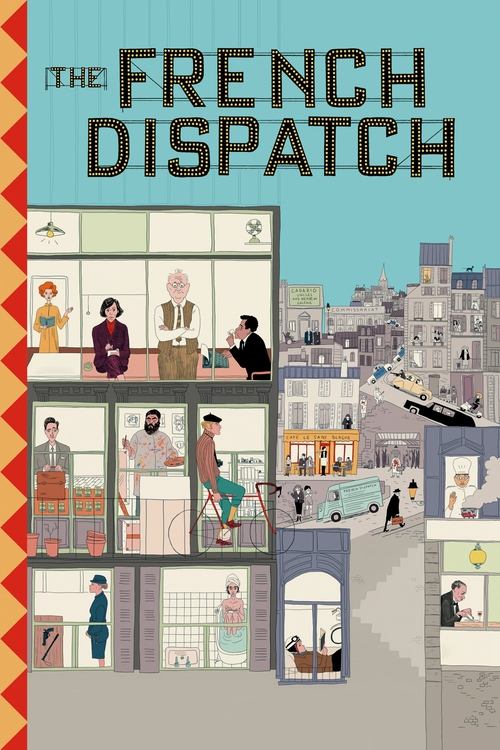
The French Dispatch of the Liberty, Kansas Evening Sun
Plot
The staff of an American magazine based in France puts out its last issue, with stories featuring an artist sentenced to life imprisonment, student riots, and a kidnapping resolved by a chef.
Get the Weekly Woke Watchlist
New and trending movies scored for woke bias, preachy messaging, and forced political themes — before you waste your evening.
No spam. One useful email per week.
Overall Series Review
Categorical Breakdown
Characters are predominantly defined by their unique quirks, passions, and professional roles, not by an intersectional hierarchy or immutable characteristics. A core journalist character is a Black, gay man, and his identity provides a political context for his experiences, such as his imprisonment, though his narrative focuses on a high-speed adventure and his writing. The overall focus is on character merit and the artistic process, not a lecture on systemic oppression or the vilification of a specific demographic.
The film is set in 'Ennui-sur-Blasé,' which translates to 'Boredom-on-Jaded,' immediately framing the central French culture with a sense of weariness and critique. The second vignette focuses on student protests and a manifesto that challenges societal institutions, compulsory military service, and pre-ordained futures, representing a deconstruction of the 'home culture.' The overall tone is one of nostalgic, cynical detachment rather than outright demonization of ancestors or a celebration of the 'noble savage' trope.
Female characters are often professional and highly competent, such as the journalist Lucinda Krementz or the prison guard Simone. However, Simone is primarily the 'artist's muse' to a male genius, and a female revolutionary, Juliette, is sometimes treated like a child or less impressive than her male counterpart. The narrative focuses on careers, art, and intellectual pursuits, providing no commentary on motherhood or traditional family structure, which moves it away from both the high-score 'Girl Boss' trope and the low-score 'Complementarianism' ideal.
One of the central reporters, Roebuck Wright, is a Black, gay man whose sexuality is acknowledged as a reason for his past imprisonment in the fictional French city, reflecting the historical reality of the era. The narrative presents this as a biographical fact that informs his outsider status and melancholy, but his story is not centered around a queer theory lens, gender ideology, or a deconstruction of the nuclear family.
There is no explicit mockery or active hostility toward organized religion, specifically Christianity. However, the film's pervasive tone is highly cynical and postmodern, with characters and narratives engaging in self-mockery and intellectual detachment, suggesting morality is subjective and passion is the highest truth. This results in a spiritual vacuum where an objective, transcendent moral law is entirely absent from the story's concerns.
Get the Weekly Woke Watchlist
New and trending movies scored for woke bias, preachy messaging, and forced political themes — before you waste your evening.
No spam. One useful email per week.