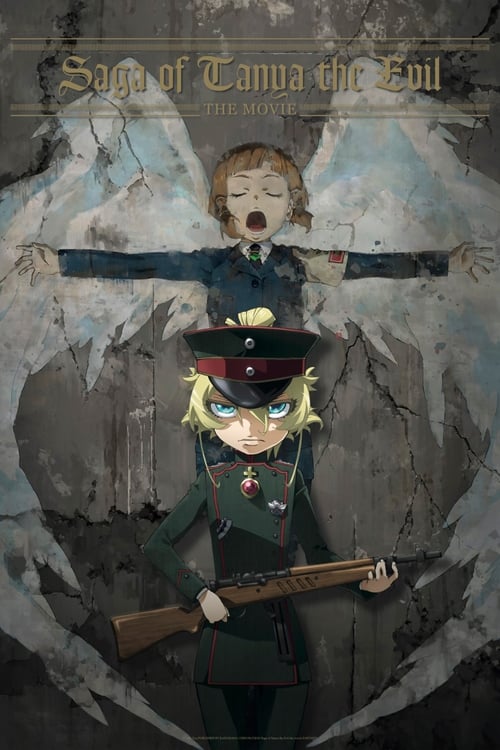
Saga of Tanya the Evil: The Movie
Plot
The time is UC 1926. The Imperial Army's 203rd Air Mage Battalion led by Major Tanya Degurechaff has won the battle to the south against the Republic's stragglers. They expected to be given a vacation after returning victorious, but instead receive special orders from Staff HQ as soon as they get home. They are told that there were signs of a large-scale deployment near the Empire-Federation border. Faced with the prospect of a new major enemy, the desperate Empire fans the flame of war. Meanwhile, an international volunteer army spearheaded by the Commonwealth set foot in Federation territory. As they say, the enemy of an enemy is your friend. They suffer through misfortune purely out of national interest, and among them is a young girl. She is Warrant Officer Mary Sue, and she takes up arms hoping to bring the Empire, who killed her father, to justice.
Get the Weekly Woke Watchlist
New and trending movies scored for woke bias, preachy messaging, and forced political themes — before you waste your evening.
No spam. One useful email per week.
Overall Series Review
Categorical Breakdown
Characters are judged solely on their tactical competence, ambition, and ruthlessness within the military hierarchy, which operates on a principle of universal meritocracy. The Empire is a European-analog nation, and the conflicts are entirely ideological and nationalistic, not based on immutable characteristics or a critique of whiteness.
The film does not frame its Western-analog civilization, the Empire, as fundamentally corrupt or racist. Instead, the Empire is depicted as a hyper-efficient, if ruthless, meritocratic war machine that provides a structure for the protagonist to survive. The primary external enemy, the Russy Federation, is portrayed in a negative light as an irrational and oppressive Communist-analog state, running counter to the concept of civilizational self-hatred.
The protagonist, a former adult male salaryman, is now a female child soldier, complicating a standard gender analysis. Her power is a result of prior-life knowledge and a magically-coerced divine blessing, not innate female superiority. She is far from a perfect 'Mary Sue' and is constantly undermined by her own cynical planning and the machinations of Being X. The narrative avoids anti-natalist messaging, focusing entirely on military life and strategy.
The main character is a male soul inside a female body, a narrative premise established as a cosmic punishment, not as a celebration or lecture on gender theory. This premise, while involving a gender change, is a source of dark comedy and a means to explore philosophical conflict. The story does not deconstruct the nuclear family, and the primary antagonist is motivated by the traditional family value of revenge for her father.
The core plot is a direct, hostile argument against a divine entity, Being X, who is explicitly portrayed as a manipulative, sadistic, and petty god-figure. Being X actively interferes in human affairs, causing war and suffering purely to force the atheist protagonist to be pious, framing the divine as a source of all global chaos and misery. The protagonist’s worldview of militant atheism and rational self-interest is constantly validated over traditional faith.
Get the Weekly Woke Watchlist
New and trending movies scored for woke bias, preachy messaging, and forced political themes — before you waste your evening.
No spam. One useful email per week.