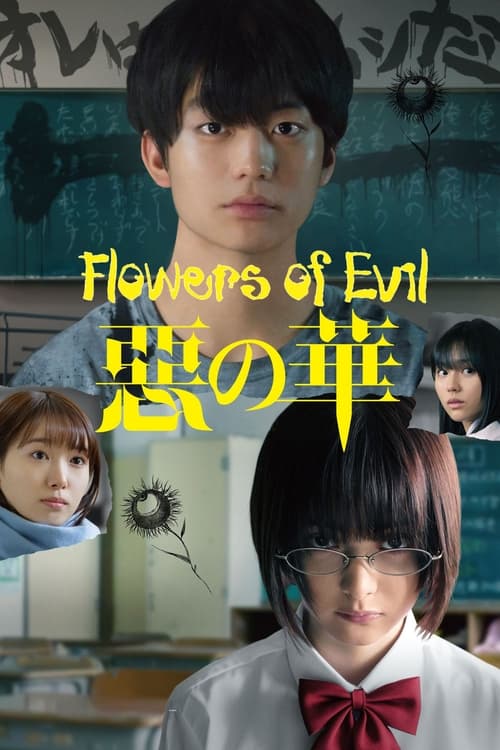
The Flowers of Evil
Plot
A high school student steals the panties of a girl he likes but is witnessed, which sets off a chain of events that send his life and the lives of others around him out of control.
Get the Weekly Woke Watchlist
New and trending movies scored for woke bias, preachy messaging, and forced political themes — before you waste your evening.
No spam. One useful email per week.
Overall Series Review
Categorical Breakdown
The story is set in a small Japanese town, and all characters are Japanese, making issues of race and whiteness entirely irrelevant to the plot or themes. Characters are judged solely by their inner moral/psychological state and their willingness to embrace their 'perversion,' which constitutes a non-political, universal meritocracy of the 'soul' rather than a social hierarchy.
The female character, Sawa Nakamura, expresses a deep-seated contempt for her home, viewing the local townspeople as 'shit-bugs' and their lives as 'boring and lifeless.' The main plot involves her attempt to force the protagonist into acts of desecration and vandalism against their shared community as an act of rebellion, seeking a mythical 'other side' and actively rejecting the values of their immediate society and parents.
The core relationship is a master-slave dynamic where the female lead, Nakamura, is the dominant, forceful, and sadistic intellect who blackmails the male lead, Kasuga, into submission. The male protagonist is portrayed as extremely passive, weak, and easily manipulated, serving as a foil for her psychological intensity. This strong, aggressive female dominance over a bumbling, emotionally fragile male is a clear example of male emasculation as a central narrative device.
The narrative is intensely focused on exploring complex, repressed, and non-normative *heterosexual* sexual dynamics, including voyeurism, fetishism, and sadomasochism, as part of adolescent psychosexual development. The story explores the 'perverse' nature of desire but does so within the traditional male-female pairing, and it does not center on alternative sexual identities, gender theory, or the political deconstruction of the nuclear family.
The movie's entire philosophical backbone is rooted in Charles Baudelaire's *The Flowers of Evil*, which elevates 'evil' and moral decadence as a grotesque but necessary response to the banality of life. The protagonist's struggle with his actions is constantly framed by the language of 'sin' and 'purity,' and the female lead's central mission is to force him to abandon all social and moral constraints to embrace his true, depraved self. This is a direct narrative promotion of moral relativism and the destruction of objective moral law.
Get the Weekly Woke Watchlist
New and trending movies scored for woke bias, preachy messaging, and forced political themes — before you waste your evening.
No spam. One useful email per week.